The Importance of Listening to Your Body During Different Yoga Practices
Walk into a contemporary yoga studio, and the visual cues often point toward precision, uniform geometry, and athletic endurance. Mirrored walls reflect rows of practitioners striving to replicate identical angles, while social media feeds flood our screens with photogenic, contortionist-like poses. In this performance-driven environment, it is remarkably easy to forget that yoga originated as an internal, somatic inquiry rather than a spectator sport. When the desire to achieve an external shape overrides the internal signals sent by your nervous system, a practice meant to heal and restore can quickly turn into a source of chronic strain.
Listening to your body is not a vague, romantic platitude. It is an active biomechanical discipline and an essential safety mechanism. Because human skeletons, connective tissues, and daily energy reserves vary dramatically from person to person, no two bodies will ever experience a posture in the exact same way. Learning to decipher your body’s subtle communications across contrasting styles of yoga is what transforms physical movement into a sustainable, lifelong discipline.
Skeletal Architecture and the Myth of Universal Alignment
Much of the frustration in yoga arises from the mistaken belief that alignment rules are universal. Traditional cueing often instructs students to place their feet at precise ninety-degree angles, square their hips completely forward, or fold until their chest rests flat against their thighs. While these guidelines provide a helpful starting framework, they often collide directly with human anatomy.
Every individual possesses unique skeletal variations that dictate range of motion. The depth and angle of your hip sockets (the acetabulum), the torsion of your femur bones, and the orientation of your lumbar vertebrae are determined by genetics, not flexibility.
When you move into a deep posture, you eventually hit one of two physical boundaries: tension or compression.
-
Tension occurs when soft tissues—muscles and fascia—reach the end of their current elasticity. This sensation feels like a broad, healthy stretch that releases gradually with steady breathing.
-
Compression occurs when bone makes contact with bone or when joint capsules are physically pinched. No amount of mental focus, breathing, or sheer willpower will lengthen skeletal bone.
Attempting to force a joint past a compression point to achieve an aesthetically “correct” shape exerts destructive torque on labrums, menisci, and intervertebral discs. By tuning into local sensations, you can recognize when your skeleton is signaling a hard stop, allowing you to back off before structural tissue sustains damage.
Decoding Somatic Signals Across Contrasting Traditions
Different yoga styles place unique demands on the musculoskeletal and nervous systems. An internal cue that signals safe progression in one style may indicate acute risk in another. Cultivating physical awareness requires tailoring your attention to the specific physical environment of the practice.
Dynamic Vinyasa and Power Flow: Guarding Against Repetitive Strain
Vinyasa yoga links breath with rapid, continuous movement. While this flow generates cardiovascular heat and dynamic stability, momentum can easily mask compromised form.
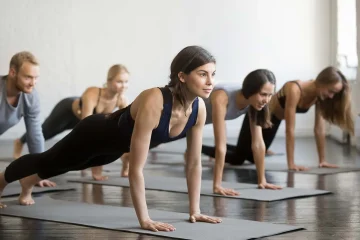
The primary danger in fast-paced classes is cumulative repetitive strain, especially within the shoulder girdle and lower back. Moving through dozens of transitions from High Plank to Chaturanga and Upward-Facing Dog places significant shear stress on the rotator cuff and anterior shoulder capsule.
If your core fatigues halfway through class, your body will instinctively compensate by dumping weight into the lumbar spine or collapsing the wrists. Listening to your body in a flow class means recognizing when fatigue has eroded your structural integrity. Dropping knees to the mat during a transition or resting in Child’s Pose is not a sign of weakness; it is an intelligent decision to protect your joints from sloppy mechanical loading.
Hot Yoga: Navigating False Flexibility and Thermal Stress
Practicing in a heated room (typically heated anywhere between 90 and 105 degrees Fahrenheit) dramatically alters how tissues behave. External heat dilates peripheral blood vessels, warms synovial fluid, and increases the pliability of muscles and tendons.
While this warmth allows you to slip into deeper stretches with minimal initial resistance, it can create a dangerous illusion of flexibility. Ambient heat softens connective tissues before your neuromuscular system has built the active stability required to support that increased range. Ligaments, which possess minimal blood supply and do not bounce back once overstretched, can easily be compromised if you push into extreme end-range positions without muscular engagement.
Furthermore, thermal stress demands vigilance regarding systemic signals. Lightheadedness, nausea, or a sudden cessation of sweating are clear symptoms that your cardiovascular system is struggling to maintain core thermoregulation. Stepping back, resting on your mat, and prioritizing slow nasal breathing must take precedence over completing another set.
Yin and Restorative Yoga: Distinguishing Healthy Fascial Load from Joint Distress
In contrast to dynamic practices, Yin yoga involves holding passive floor postures for three to five minutes at a time with relaxed musculature. The objective is to gently stress the deeper, plastic fascial networks, joint capsules, and ligaments.
Because these postures are quiet and prolonged, they require a refined internal radar. The sensation you seek is a broad, dull, and tolerable ache spread across muscular and fascial planes.
Conversely, sharp, shooting, burning, or pinching sensations indicate acute impingement or excessive joint distraction. Any sensation resembling pins and needles or radiating numbness means a peripheral nerve is being compressed. When these sharp warnings occur, staying in the posture does not build mental fortitude; it invites chronic inflammation. Micro-adjusting your angle or using supportive props relieves nerve compression while keeping the beneficial fascial load intact.
Cultivating Interoceptive Awareness Through the Breath
The primary vehicle for listening to your body is interoception—the neurological capacity to sense internal physiological conditions such as heartbeat, muscle tension, and breath rate. In a culture that heavily prioritizes external productivity, many individuals arrive on the mat partially dissociated from their physical sensations.
Your respiratory pattern serves as the most immediate, unvarnished diagnostic tool on the mat. During a well-regulated practice, the breath remains smooth, rhythmic, and diaphragmatic through the nose. The moment your breath turns ragged, shallow, or catches in your throat, your sympathetic nervous system (the fight-or-flight response) has taken control.
Breath retention is your body’s subconscious way of bracing against threat or pain. Whenever you notice yourself clenching your jaw or holding your breath to survive a posture, your nervous system is telling you that you have pushed past your body’s threshold of safety. Softening the depth of the pose until rhythmic breathing resumes allows the parasympathetic nervous system to remain online, signaling to your brain that the stretch is safe.
Reclaiming Props and Modifications as Advanced Practice
A persistent stigma in modern yoga culture suggests that using blocks, straps, and bolsters is a concession reserved exclusively for beginners or those working through injuries. This misconception causes countless practitioners to sacrifice their alignment and spinal health simply to touch their toes or plant a hand on the floor.
In reality, utilizing props is a hallmark of an advanced, discerning practice. Placing a block under your hand in a Half Moon or Triangle pose lengthens the spine, uncompresses the lower back, and frees the diaphragm. Using a strap in a seated forward fold allows your pelvis to tilt forward over the femur heads, protecting the fragile hamstring attachments at the sit bones from micro-tears.
Viewing props as tools for structural optimization rather than crutches shifts the internal dialogue. It allows you to tailor the practice to the exact dimensions of your body on any given day, respecting that energy levels, joint hydration, and muscular tension fluctuate constantly based on sleep, stress, and daily demands.
Yoga is fundamentally an ongoing conversation between your mind, your nervous system, and your physical tissues. When you treat the mat as an arena to prove flexibility or chase visual ideals, you disconnect from the very awareness the practice seeks to cultivate. By honoring skeletal reality, adapting to the demands of different styles, using breath as your guide, and embracing purposeful modifications, you build a sustainable practice that nourishes your body rather than wears it down.